02
Equity Considerations
Equity approach
A combined weighting based on both of the following factors:
- Past wins: The number of times a registrant has won a ticket in a previous cycle.
- Opportunity level: The level of children's access to opportunity linked to the registrant's zipcode, based on the 2023 Child Opportunity Index.
Reasons for choosing this approach
- Lowering barriers to access: Weighting is based on a widely-adopted methodology that directly assesses children's access to opportunity, based on educational, social, and economic factors. The tool is referenced on the Massachusetts Department of Public Health website.
- Citywide data coverage: Data exists citywide and covers all census tracts, unlike other Boston Public Schools-specific datasets. This addresses a concern raised in the one-pager that more BPS data is available than for non-BPS kids.
Other approaches considered
- District population weighting: The focus of the project is to support families facing greater barriers to cultural access, rather than to ensure proportional representation for each Boston district. Moreover, accounting for disproportional interest closer to the event venue can unintentionally worsen inequity, as cultural resources may be concentrated in more wealthy areas. It can also be complex, as the initiative facilitates tickets for multiple event venues.
- BPS Child Opportunity Index: While the BPS-specific child opportunity index is more granular than the zipcode-level index, it excludes non-Boston Public School kids.
Calculation formula
-
Child Opportunity Index (COI) data (version 3.0, published in
2025):
The 2023 Child Opportunity Index dataset includes zipcode or
census tract-level classification of children's access to
opportunity. To implement this approach, use the
c5_COI_metdata variable, which compares each zipcode with Boston-Cambridge-Newton, MA-NH. Select the 2023 data. Each zipcode is classified as having very low, low, moderate, high, or very high child access to opportunity. -
Weight formula for Child Opportunity Index (COI):
Current presets per neighborhood level:
- Very low = 1
- Low = 0.9
- Moderate = 0.8
- High = 0.7
- Very high = 0.6
-
Weight formula for past wins:
weight = 1 / (1 + pastWins)- pastWins = 0 → weight 1.0
- pastWins = 1 → weight 0.5
- pastWins = 2 → weight 0.33
- pastWins = 3 → weight 0.25
Each time a registrant wins the lottery, their chances of winning again decrease.
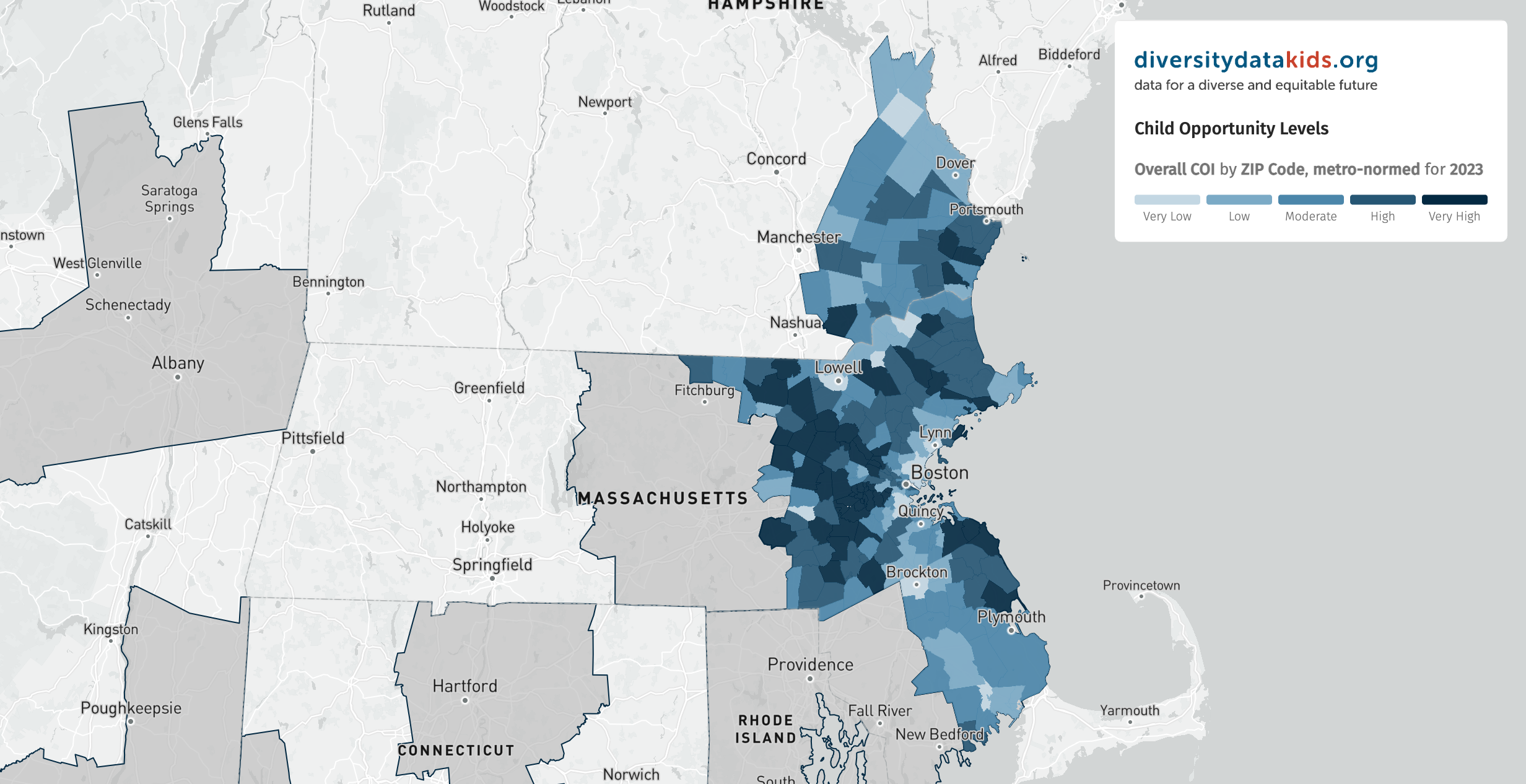
Source: DiversityDataKids
Best practices for transparency
-
Communicate the basis for equity weighting:
Public users should be informed that the system uses the
rigorous and peer-reviewed Child Opportunity Index (COI).
The COI is a project housed in Boston University's School of Social Work: Institute for Equity in Child Opportunity & Healthy Development. Child Opportunity Index page.
Share the map visualization to indicate how the system considers the level of access for a user's neighborhood. -
Include a specific scenario: Make the weighting
system more intuitive for users by providing a concrete
example.
E.g., A user from a "very high" access neighborhood with one past win has one-third the likelihood of being selected compared to a first-time user from a "very low" neighborhood.
Considerations and limitations
- Zipcodes vs. census tract: Some zipcodes contain high variability in opportunity. Census tracts map more cleanly to differences in opportunity access, but zipcodes map more cleanly to registrations. In the long run, it is worth considering switching to census tracts.
- COI selection: There are different types of COI: Overall Child Opportunity, Education, Health and Environment, and Social and Economic. We recommend choosing Overall Child Opportunity to consider child opportunity access comprehensively.